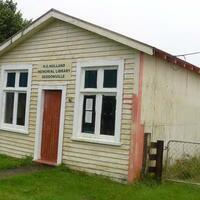
Reading: Hana Pera Aoake, writing in Overland, on the photography of John Miller. He “demonstrates what showing up and reciprocity looks like”.
“The author is not dying a second time. The author is splitting into two distinct figures with increasingly divergent social functions. On the one side, the Administrative Author: the person who holds the institutional position, the copyright, the reputational stake, the liability, without necessarily having performed the cognitive act that once gave those holdings their justification. On the other, something we do not yet have a fully adequate name for: the thinker who earns authorial aura precisely by demonstrating, in formats that cannot be faked or delegated, the capacity to engage with a problem frictively, in real time, at genuine intellectual cost.”
This from Anchit Sathi’s “AI and the Crisis of the Author”, a meditation on copyright law, ‘cognitive friction’, Barthes' call for the death of the author, Amazon’s meeting culture, and much else besides. I read it this morning and found it (usefully) troubling. Going onto the TLS website to provide a link I find this note: “We have removed this essay. AI was used in its preparation. The TLS editorial guidelines prohibit the use of AI in the writing and editing process. The author states that he was unaware of the policy.”
The accountability of language
I’m glad Alan Jacobs put a link to Wendell Berry’s “Standing by words” (1980-81) on his blog. I don’t know Berry’s work at all, really, and have been catching up as I can since the news of his death. These lines, ones Jacobs quotes, caught me too:
“glibness is an inescapable doom of language without standards. One of the great practical uses of the literary disciplines, of course, is to resist glibness — to slow language down and make it thoughtful. This accounts, particularly, for the influence of verse, in its formal aspect, within the dynamics of the growth of language: verse checks the merely impulsive flow of speech, subjects it to another pulse, to measure, to extra-linguistic consideration; by inducing the hesitations of difficulty, it admits into language the influence of the Muse and of musing.”
"Did you ever love somebody?"
Travelling Miles (1999) is the only one of Cassandra Wilson’s albums I’ve known well and had part of my life properly (“Right Here, Right Now” in particular). Her NYT obituary has me working through the rest of the catalogue, as does this quote: ““We live very segmented lives […] There’s Black music and there’s white music. There’s R&B and funk and whatever. This has always bothered me. People don’t see things in streams, they don’t see what tends to connect us all together. That’s what I see. That’s what I try to get at.” We need more handshakes, as Hone Tuwhare put it, in every cultural direction.
Uncle Vanya
Fires, floods, strained social orders, intergenerational struggle over property, lost standing, decay and unease . . . it wasn’t at all hard to find contemporary parallels in Uncle Vanya, opening at Circa last night (and running until 10 October, and worth your time), and Andrew Foster’s adaptation did nice working making the ‘scenes from country life’ ring from Chekhov’s day to ours. More important for me, thinking on the performance the morning after the night before, was the energy of it all. Carmel McGlone, surely one of Aotearoa’s best character actors, doesn’t have enough to do as Maria - blame Chekhov for that, but, and what she does do she does! As do Tawhi Thomas as Vanya, Kali Kopae as Helena, all six of the actors across the night.
All that great Russian gloom is translated somehow properly into a New Zealand gloom (Patrick White: “I shouldn’t be surprised if any New Zealander took a gun to his neighbour. Guns are to New Zealanders as axes are to Poles”)! It was oddly cheering, for reasons I don’t understand, to feel it all settle in and see it acted out so well. Disappointment; death; despair; discord. All the usual. I’m glad I went.
End-times fascism - “with its fortressed borders, decimated foreign aid and fixation on grabbing the resources beneath Greenland’s melting ice” as “a twisted and sadistic form of climate-change adaptation.” Naomi Klein and Astra Taylor in the FT. “Now that the reality of planetary heating has become undeniable, all that is left to deny is the humanity of our fellow humans.”
"the whole point is to do things the hard way"
Academics are especially susceptible to flattery, working, as we do, in such a hierarchical and status-obsessed profession. It’s no surprise then, really, that we’re prime candidates for AI blethers and its confidence men. All of that smooth language about efficiency and savings in grunt work and tedious tasks carries, just out of sight and not quite within reach, the promise that you’re too good for all of that. Tempting! But, of course, all of that is how we learn. And, often, what we learn too.
“The whole point is to do things the hard way, because that’s how you learn”, William Hubbard, of U of Chicago’s Law School, tells the FT’s Patti Waldmeir. I like the American sincerity of what he says next (and I believe him): “There are core aspects of the practice of law that are not about what’s in the books but what is in the human heart and soul. There is something very human about the lawyer’s job, someone is in a bad place and they know they have someone in their corner fighting for them.”
Dance-Floor Romance
Chris Tse’s (exuberant, glorious, poised, witty, wise) Dance-Floor Romance comes out this week, and I hope for it every success and well wish in the world. Tse has become one of our civic poets, making a space for his writing just to the side of the political and the demands of the moment and thus looking and listening in and on it in rewarding ways. It’s a role I never imagined for him as he set out (he’s a poet I don’t know personally at all, but I’ve bought each of his books as they’ve come out and have grown and changed as a reader under his tutelage), and one he’s made wonderfully his own. It’s a recognisable New Zealand and Bardic role (from Baxter in the 1960s to Wedde before the 1990s), but one now rightly different and distinct. It’s nice, this morning, reading Jackson McCarthy’s review (the book’s first?) and finding him responding to the _ourness _ of this mid-period Tse. Jackson hears the love chord sounding across Dance-Floor Romance as “a restatement of the lyric within the civic”. That seems right to me, and rightly put.
Mid-period Chris Tse puts me in mind of mid-period W.H. Auden. There’s a new relaxation and expansiveness, without ever loosening to slackness, complementing an earlier tension. There’s the sense of a public voice sounding itself in private places, and of private places being brought into public spaces. There’s a pleasurable delight in music and musicality, about the house and domestic without ever being fully domesticated and while staying knowingly unhoused. Tse is a poet aware of his place and of his responsibilities to place and to people, his head and mouth full of the noises and sounds and voices of his lands but prepared, on occasion, to talk back to them and to us. This collection, like Auden’s middle works, is comfortable in its own poetic skin and prepared to slip out of that skin when required. The verse is playful, toying, energetic, spry, sexy, winningly confident and charming and sly while also, like the rest of us, frightened, vulnerable, at risk. And it’s all………very gay.
There’s a pleasing sense across the collection of a poet aware of his skills and his craft and stretching himself out, trying a few new things, scratching some old itches and inhabiting a few different roles. There’s a tenderness and care on display (‘Please. Be here now.’) that was often kept fairly tightly constrained in the earlier collections. This is a collection of consolidation and expansion rather than a radical break or a new departure, but none the worse for that. The feeling of a deepened, more sophisticated, more rewarding and more extended encounter with interests Tse has had so far (ekphrasis, for instance, or engagement with pop music, or responses to other writers as interlocutors) make this a companion volume, and a companionable volume, to the post-How To Be Dead in a Year of Snakes Tse canon. Again, this brings Auden to mind: Tse is revising, reworking, developing sounds and images in a sound- and vision-world he has made his own, just as Auden’s great collections of the 1940s and 1950s peopled and populated (via opera rather than pop ballads, in his case) a fleshly, human, inhabitable gay world his earlier poems had longed for but never been able to wish into existence. I want to call the aesthetic on display here ‘tinkering’ without that term seeming belittling. Tse is in control of his inheritance: he is in the workshop, at play, busying himself with the tools to hand and knowing what to do with them. He is producing variations and, with each variation, a new pleasure and a new insight comes into view. Is it surrender or ecstasy? Yes, please.
This is clearly a collection by someone who has been Poet Laureate, without being burdened down by reading as a ‘Poet Laureate’s collection’. There’s an assurance to the voice, and (Auden again!) a nice and productive imbalance that comes in a few poems from speaking publicly in private (and privately in public), connected surely to the training and expectations of having functioned as a representative for Poetry across a few years. None of that should be mistaken for self-seriousness or absorption, but: when Tse steps in the room he can make the whole place shimmer.
above all this, I wish you love
“Farther along we’ll know all about it,
Farther along we’ll understand why;
Cheer up, my brother, live in the sunshine,
We’ll understand it all by and by.”
One of the pleasures for me in Emma Adler’s “Every novel is boring - until it isn’t” (at Public Books) is how contrary it seems to my own experience. Adler writes of the “volta” in a novel, a turn that, unlike the sonnet’s, is much more subjective and experiential, “a shift to visceral enjoyment” after the lulls of bored anticipation. It’s a smart essay, and a fun one. But surely also wrong! Oftentimes it’s the order and elegance and promise of an opening chapter, or opening sentence that engages me. Muriel Spark! “Daylight was appearing over London, the great city of bachelors.” And then, eventually, the realisation (or the inability to keep half-acknowledged) that I am reading “in anticipation of retrospection” sets in, and with it kinds of boredom or lagging attention. Even the best novels (like life) promise more than they can fully deliver. And every ending (again like life) is difficult because it brings to a close what, if we’ve been made a part of its reality, is the experience of the novel.
Ways of Seeing!
As the bus was between Gledenning Ave and Buccleugh St on North Rd this morning I turned to see Sacred Heart Church and, in the morning light, it looked as if Robin White had painted it, the hills and bush behind it, the hedge to its side. A man, troubled, got on at the next stop and, with his eyebrows and lined face, seemed as if he were a figure in a Jeffrey Harris painting. A glimpse through a window on the early part of the walk up North Rd showed a scene, ‘imagined in the context of a room’, as if framed by Joanna Margaret Paul.
If the poets teach the free man how to praise then the painters teach us how to see. It’s been a day when the gift of all of that seeing has been clearer than usual, and I’m grateful to them all.
good tidings for those who died stifled by unrelieved calamities
Would you like to learn how to utilise Co-Pilot, ChatGPT and Claude? I would prefer not to.
And Brad East reminds me that I am free to say “no”.
Sick at heart
Terry Eagleton, writing in COMMONWEAL:
“The scholarship boy typically feels that he has betrayed his parents, not that he has done away with them. Was I glad that my father was dead, as well as distraught? Was his end necessary so that I might begin? When I became a don I was the youngest fellow of my college since the eighteenth century, an era to which some of my colleagues seemed anxious to return. I had set my foot on the escalator that was to bear me up and away from the speechless man I had left on his deathbed. Then I moved to Oxford, uncertain whether I should reject the place in my father’s name or embrace it for just the same reason.”
I’ve not kept up with Eagleton’s books these past years, but I’ll be reading A DEATH OF ONE’S OWN.
The Cutting Edge
Nate Wooley’s tribute to Sonny Rollins at n+1 reminded me I’d never listened to anything more than Way Out West, and, to fix that gap, I’ve been listening to The Cutting Edge, a live album of Rollins at the Montreux Jazz Festival in 1974. And that (in the closing track, “Swing Low, Sweet Chariot”), took me to Rufus Harley, the only jazz bagpipe player I think I’ve ever heard. Glory be.
next to god of course america i
A found poem:
I think that’s a negative view, to be honest.
Like: we’re entrepreneurs and
business people, and
I get it.
You know, if you’re not retooling and radically disrupting your
business,
you ain’t doing the job.
You know, you have to disrupt yourself aggressively
before you get disrupted by global events,
and if you keep thinking you want
the same business model,
the same customer mix,
the same margin structure,
you know you’ve got to be
retooling and
refinancing and
rehoming, and
that’s just the reality of
business people
all around the world.
So, my job is to make sure I’m setting up the conditions
for you to be able to go create that growth.
And I think some of the subtext and assumption in your question is that
I think in New Zealand
I’ll be honest with you as a
business person who was …
I sat in Illinois for six years in Chicago, and the last person I wanted to ever talk to as a CEO was the government.
I didn’t sit there in Chicago saying I wonder what the government thinks and I wonder what they’re doing to help me for my business?
Can I get some grant money to do something?
No!
No.
I’m a business person.
I’m building a kick-ass company that actually has
commercially superior returns,
great customer experience, and
awesome internal culture.
That is the job of what makes a great company,
not a good one,
a great one.
And so that was my mentality.
Come home to New Zealand, and there’s a parent-child mentality.
I have literally sat in boardrooms across New Zealand,
The conversation goes: I wonder what the government’s going to do?
I wonder what the government’s going to think?
Who cares what the government thinks or does?
Our job is to be adult,
adult,
adult.
The business leaders,
the political leaders, and
the community leaders
working together,
doing things differently.
I set up the operating system.
You go out there and smack it and
go create the road, and
the community leaders see the pain,
the hurt,
the need, and
the frustration, and
the three actors do different things
(but complementary things)
to deal with the challenges and
the opportunities.
Vale Ian Jamieson
I am sorry to read in THE POST this morning that Ian Jamieson has died.
Ian taught in the English Department at Otago when I was there as an undergraduate, and was an inspiring, eccentric, lively and completely winning lecturer. I wasn’t at all keen to do Middle or Old English, compulsory subjects in those days, but was quickly converted to the pleasures of both - and to the wonders of Chaucer - by his energy, obvious delight in his subject, nicely controlled zaniness. Lots of it, I realise now, was a carefully-prepared performance and presentation aimed to win and keep our attention. It worked! At the time it seemed like a free-wheeling, improvisatory and slightly messy ramble through the works of writers Jamieson talked about like they were old friends. Lecturing needed more showmanship and dazzle in those pre-PowerPoint days, and Ian was a great razzle-dazzler. I’ll try and read some Robert Henryson this weekend in his memory.
Like Lachlan Brown
Lachlan Brown read, and talked about, winningly, his sonnet “Listening In” at ASAL in Brisbane last month, and I ordered his books from Marsden Books that night. They came this week and both confirm all the stirring and sense of pleasurable anticipation “Listening In” set in motion. Established and in the world, Lunar Inheritance (2017) and Limited Cities (2012) are new for me and full of surprises.
Lunar Inheritance I’ll be thinking with for a while longer but, on my second reading of Limited Cities, what’s sticking in memory are all of Brown’s striking similes. Some of these are charming in their unexpected rightness (the job of a simile, yes?): a rubbish truck “setting down its bins / like a triumph of empty glasses”; a train seat snapping shut “like a sharp rebuke or a director calling cut.” Even theorists “lining up late like Thursday / night wheelie bins”. Nice!
Something else is going on in this collection too. A simile is a comparison that, in its vividness, is always admitting to an _un_alikeness, and drawing attention to the way things aren’t identical. As if . . . like . . . as . . . like . . . the chain, really, loops endlessly and never settles. Simile in Brown seems to be a kind of default way of trying to capture things as they are and also experiencing things in motion and fleetingly. That’s partly to do with thinking in and with the suburbs (“this part / of the city that is not / the city”) and thinking in and with trains and commuting and being in between work and home, “somewhere / in between”. Brown is good about these experiences (these are good poems - beautiful poems - to read if you’re interested in trains and public transport and train networks as things of wonder on their own terms), and he’s also a good poet with them. A profusion of similes - of things being like another and admitting their unalikeness, and of suburbs being as and of and like the city without ever quite being the promise of the City - feel, in ways I’m not quite sure I understand yet, to do with the lasting damage of the Howard years, and what that meant for our generation in Australia (we’re contemporaries), and what those long years of low interest rates and big mortgages and politics built on both did to collectivity, solidarity, location. Brown writes of a “chessboard suburb”, where “every lung expands and contracts / with its own economy; each breath another / loan repayment”. There’s a lot of property talk in these poems too, a sign of someone taking contemporary Australia seriously.
Compassion, too, but. I prefer Brown’s “Petrol Stations, or Nine Vouchers Without the Optimism” to Bishop’s “Filling Station” - a poem it is like, and one I appreciate all the more because it prompted me to read Bishop’s again with fresher ears and eyes - because it never lets its humour become judgement, and because it dispenses with optimism for that more difficult quality, Hope. Brown is a poet, I’m sure, reading these poems, determined to believe that Somebody does love us all. The tricky part, in this world, is finding the right ways to make that belief in Him meaningful here, in this world of tollways and hubcaps “left on a / roadside, / spinning like a coin.”
Anti-social media
About a year ago I found I couldn’t be on social media any more. There wasn’t anything particularly high-minded or principled about this; I’m someone easily distracted and with many people I love living abroad, so the trivial things lots of people complained about over the years (all those photographs of what others were eating for breakfast) always appealed. And still would, if I could find them again. That was part of what stopped working, as others better informed than me have written about: the “enshittification”, the automation, the corruption of good human habits. I’ve never been a particularly good or thoughtful friend but have always felt that I ought to be one, or at least try to be better. Before Facebook I was bad at remembering birthdays; after it I stopped trying. The distress and distressed distraction that came from the hyper-presence of images of genocide and injustice and suffering didn’t mobilise me to greater action or clarity about those injustices, either; cumulatively, the images acted as barriers to action. And the strange hyper-public of these commoditised spaces (everyone a holder of a “platform”!) made meaningful speech harder to attend to or to form.
More difficult, and more significant, was the overall “context collapse”. Patricia Lockwood’s “The Communal Mind” should have been a warning. I don’t want my mind to be structured in the ways that essay so brilliantly explores, and don’t think it needs to be. I haven’t Lockwood’s agility (or intellect), for one thing. For another, I’m less sure that we need, as writers and thinkers, to accept that this is the cultural logic of the age or the way the structure of feeling is to be found. Those with money to make from all of us being on their platforms all the time want us to think it’s the “Age of AI”, or the “digital era”, or whatever. Maybe. Active social media use fell sharply in Britain last year, the FT reported. Perhaps this is the beginning of an end rather than the end of a beginning. Either way, it’s not for me anymore.
Worst, really, were the things I thought I needed most (book talk and politics talk, in my case). Speed and the hyper-availability of opinion and response and opinions-in-response made both more and more confusing the more they poured through. Pope Leo writes about this, indirectly, in Magnifica Humanitas:
The third major challenge is intellectual and concerns knowledge. Without careful attention, an educational system lacking in a love for truth may emerge, in which an incessant flow of information replaces the essential exercise of research, reflection and discernment. As knowledge becomes increasingly fragmented, it becomes difficult to grasp reality as a whole, to ask profound questions about meaning, or to develop authentic, critical and creative thought. Many educators already report signs of dehumanization, where people may “know many things” but struggle to find direction in their lives, partly due to an inability to connect information with deeper knowledge or maintain a sense of purpose. A genuinely healthy attitude is needed, requiring rhythms that incorporate silence, in-depth study, reading and judicious analysis, for without these elements inner freedom may be compromised.
I was becoming one of those people. I’m trying, in my writing life and in my teaching (and my political commitments elsewhere) to re-establish some context, some distance, some silence. It feels important, at the moment, to know how to talk together about not-knowing. And the kind of criticism and literary theoretical-work I want to write I want also to be neither the “hot take” nor the puff piece. Trying to think about everything all at once - getting into the habit of forming opinions as I was encountering the material for thought itself - was training me in both kinds of deformation. Magnifica Humanitas uses the word “discernment” a lot. That’s a word with a particular meaning in the Catholic tradition, sure, and can’t be taken wholesale from its connections to the search for God’s will but, all the same: that’s what I want to learn how to find and to write towards.
Micro.blog is nice because it doesn’t have analytics or replies or any way in particular for me to worry over or get distracted by who is reading. Writing is something I need to do because it is how I think. Reading, if it is useful for you, is something you’re welcome to but can do in a sphere separate to mine. We’re engaged in an anti-social media.
You can't lie still, pretending those are dreams
If it hadn’t been raining I wouldn’t have looked down as I walked to the bus and, if I hadn’t looked down, I wouldn’t have seen this plaque. Robin Hyde lived here, on Northland Road, and left the spot ninety-eight years' back. Twenty-four years, off and on, I’ve been living in Wellington and still, in good ways, I’m discovering its part and remembering that it feels unfamiliar, out-of-the-ordinary, not at all my place.

Euchred, Eclipsed
I bumped into Dave Wilson from Te Kōki at the Hautapu at work this morning (Matariki visible, just, through the mist and city half-light and then, all of a sudden, it was dawn and light and day). And he told me about Callum Allardice, and Allardice’s “Hotere”, a composition responding, and paying tribute, to Tuwhare’s poem. It’s the opening track to [The Rodger Fox Big Band plays Hone Tuwhare], and I’d half-remembered it from that performance but, in Allardice’s own hands, is something altogether stranger, more mysterious, enchanting, alive. I’ve been listening to it on repeat all morning since.